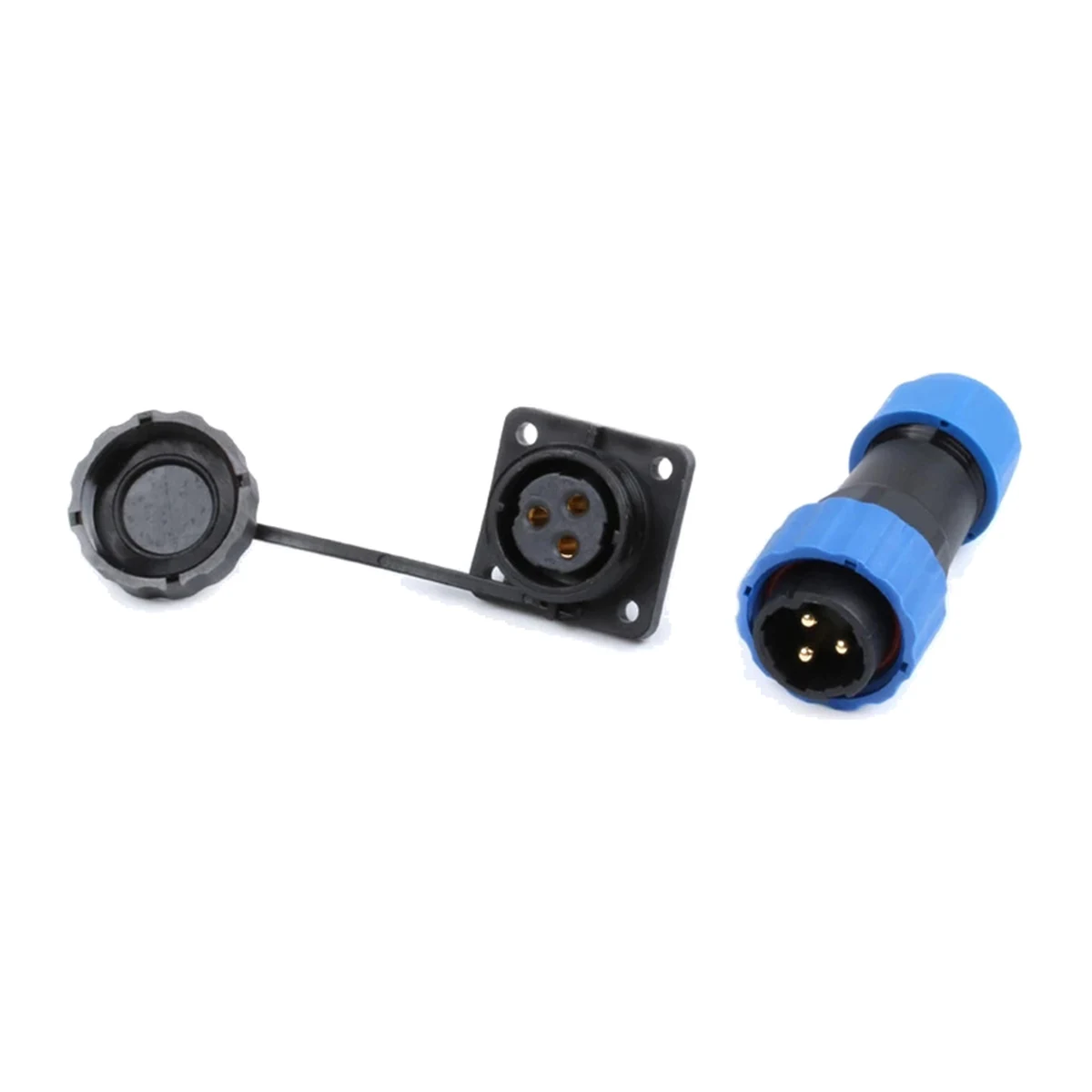
The aviation family in this catalog is twenty parts carrying 299 orderable variants. That ratio is the whole story: the parts are not twenty different connectors, they are six shells offered in different mountings, and each mounting page covers the contact counts and configurations that belong to it.
Reading a part number from the outside in — shell, then mounting, then contacts — is what keeps an order from coming back as the right connector with the wrong panel fit.
Six shells
SP13, SP16, SP17, SP20, SP21 and SP28 make up the family. Every one of the twenty parts is published at IP68 and every one carries the same 50-piece minimum, so neither sealing nor quantity narrows the choice. What narrows it is how the connector attaches.
Mounting is the first decision, not the last
Six mounting values appear across the family, and the same shell is offered in several of them:
- Inline — no panel at all. The two halves join along the cable run, which is what a harness splice needs.
- Rear-nut — the connector passes through a hole and is locked from behind the panel. Six parts use it, the most of any mounting here.
- Flange and 4-hole flange — screwed to the panel face. The 4-hole version is the one that will not rotate once tightened.
- Right-angle — the cable leaves the panel at 90 degrees, for the cases where a straight exit fouls the enclosure.
- Straight — a straight panel body without the flange or nut fixing of the other styles.
The variant count lives where the demand is
Contact-count coverage is not spread evenly across mountings. The SP13 inline page alone covers 88 orderable variants, while the SP13 rear-nut page covers 8. The SP28 pages carry 15 each, the SP20 pages 11, the SP17 rear-nut 6.
That is useful when a design is still open: if the mounting can be chosen to suit the contact count rather than the other way round, the page with the deep variant list is the one to start from. Where the mounting is fixed by the enclosure, the shorter list on that page is the real menu.
Contact count is what the current rating depends on
Rated current is published as a range rather than a single figure — 5-10 A, 5-25 A and 5-45 A across the family — because the contact count changes it. The voltage is published the same way. Both ranges belong to the part; the exact figure for a given contact count is what the variant table on the part page resolves.
This is why a connector quoted by shell alone cannot be checked against a load. The shell tells you the coupling, the contact count tells you the current.
Price follows the shell
Parts run from $2.63 to $12.38 per piece, EXW Yueqing. The bottom is an SP16 inline part; the top is SP28 right-angle. Within a shell the spread comes from the mounting and the contact count, not from a quality tier — there is one plating specification on these parts, published per page.
What to send in the inquiry
Shell, mounting, contact count and quantity. Add the panel thickness or the cable diameter where the gland has to accept a specific cable, and say whether the plug-and-socket set is needed or only one half. With those five lines the closest published variant can be confirmed against the variant table instead of guessed.