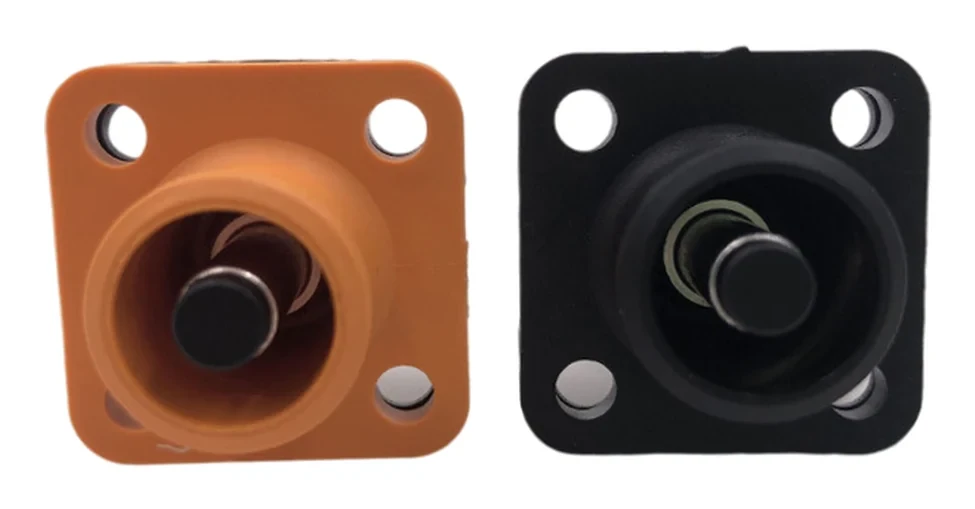
A connector family usually shares one shell and one contact system, then splits into several sockets. The differences are mechanical, and they show up as assembly time rather than as specifications.
The three terminations in this catalog
- Flat through-hole — a flat pad with a hole, bolted straight through to a busbar. Fastest to assemble, needs access on both sides.
- Long threaded stud — a stud standing off the socket, taking a ring lug and a nut. Good where the cable has to arrive at an angle or be stacked with other lugs.
- Waist-hole or threaded through-hole — a cylindrical terminal with a cross-hole, for a bolt that passes through the terminal itself. Compact, and it keeps the connection inside the socket body.
Flange and panel cut-out
Every panel socket here mounts on a flange with four holes. The flange is also where the seal lives: a gasket or an O-ring between flange and panel is a separate part, and the connector's own rating does not cover a joint that was tightened unevenly. Two practical rules apply — tighten in a cross pattern rather than around the circle, and check the flange against the panel thickness before ordering, because a long threaded terminal and a thin panel are a poor combination.
Mating direction decides the plug
Almost every plug in the energy-storage and EV ranges is a 90° elbow. Inside a cabinet that is the right shape: the cable turns parallel to the panel and the bend radius stays inside the enclosure. A straight plug is the better choice only where there is clear space in front of the socket — on a bulkhead with a service loop, for example. Choosing the plug before the enclosure layout is settled is how a harness ends up with a bend radius it cannot meet.
A short checklist
- Busbar hardware: bolt-through, stud-and-nut, or cross-hole?
- Access: can a tool reach both sides of the joint after the socket is fitted?
- Seal: is the gasket part of the socket order or a separate line item?
- Direction: does the cable leave parallel to the panel or straight out of it?
- Service: will the joint be opened again, and does the latch survive that?