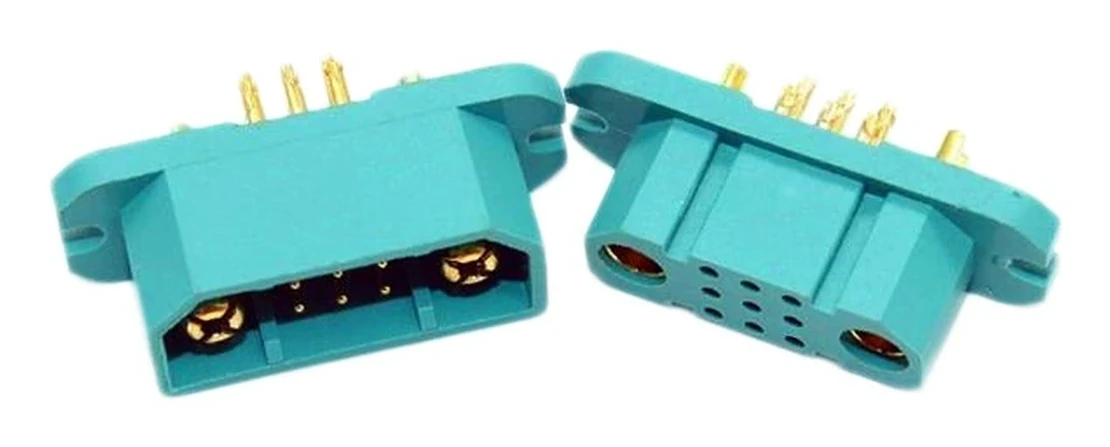
Gold plating is often sold as a premium feature. On a low-voltage harness it has a specific job, and on a mains connector it mostly does not. The difference is worth understanding before paying for it.
What plating is for
A bare copper or brass contact oxidises. The oxide layer is thin, but at low voltage there is not much voltage to push through it, so a film that would be irrelevant at 230 V becomes a measurable resistance at 12 V. Gold does not oxidise, so the contact resistance stays where it was on the day it was crimped. The benefit is stability, not ampacity: plating does not make a contact carry more current.
Where it pays
- Low-voltage, low-current signal and power pins in a harness that is connected and disconnected repeatedly.
- LED lighting runs where a fraction of an ohm shows up as visible flicker or uneven brightness.
- RC and model harnesses, where contacts are small, currents are modest and the connector is mated constantly.
- Any joint that sits for years in humid air without being disturbed.
Where it does not
High-current mains work, where contact force and contact area dominate and the oxide is broken by the mating action itself. A tinned contact in a screwed terminal is the right answer there, and plating adds cost without changing the outcome. The seven parts in this catalog are deliberately on the low-voltage side of that line: 2+4, 2+6, 2+8, 2+9, 3+6, 6-pin and 12-pin contact sets for LED and RC harnesses.
Plating is only half the joint
A gold-plated pin crimped onto a badly stripped wire is a worse connection than a tinned pin crimped properly. The catalog's 2+9 set, for example, is a solder-termination part for 14 to 26 AWG wire — the wire range and the termination method belong to the specification, and they matter as much as the plating. Where a harness is assembled in the field, a solder cup is more forgiving than a crimp; where it is assembled on a bench with the right tooling, a crimp is faster and more repeatable.
Checking a plated contact on arrival
Look for plating that stops short of the contact area, plating that has flaked at the crimp seam, and a gold colour that varies between pins in the same bag. None of these need a laboratory: they show up under a bright light, and they are the difference between a plated contact and a flash-plated one. Published prices in this catalog start at $1.13 a piece for the smallest set, which is a plating budget, not a gold-bar budget — the specification should say what thickness is expected, because the listing does not.