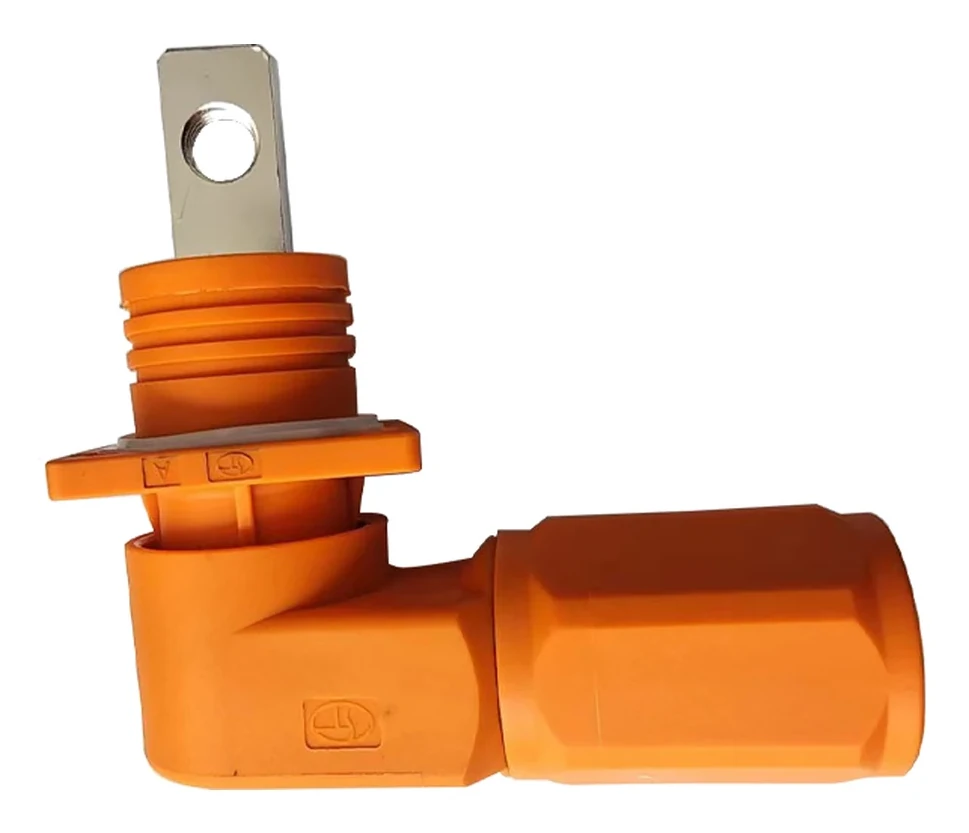
A storage cabinet is not a vehicle. The connector is bolted in once, the cable is thick, and the current is continuous rather than peaky. That changes which barrel size a project needs, and it changes what should be asked about before the part is ordered.
Four barrels, four cable ranges
- 5.7 mm — 16 and 25 mm², published at $7.88 per piece in both plug and socket.
- 8.0 mm — 35 and 50 mm², published from $9.75 to $10.88.
- 10.3 mm — 50, 70 and 95 mm², published from $11.25 to $12.00.
- 12 mm — 50, 70, 95 and 107 mm², published from $14.25 to $16.88.
The overlap between 8.0, 10.3 and 12 mm at 50 mm² is real and useful: it means a 50 mm² run can be built in three different barrel sizes, so the choice can follow the terminal and the enclosure rather than the cable.
Terminal style matters more than the barrel
Each family is published with more than one socket termination. The 5.7 and 8.0 mm parts come with a flat through-hole terminal or a long threaded stud. The 10.3 and 12 mm parts come with a waist-hole or a threaded through-hole. On a busbar in a cabinet, the difference decides assembly time: a threaded stud takes a ring lug and a nut, a through-hole takes a bolt straight through.
The plug side is a 90° elbow across all four families, which is what a cabinet wall wants — the cable turns parallel to the panel instead of standing off it.
What is not published
None of the four listings publish a rated voltage or a rated current, and none publish an IP rating. One of them prints DC5–24 V in its voltage field, which cannot be right for a 107 mm² connector in a 1500 V cabinet — it is a template value left in the listing rather than a specification. The catalog therefore publishes no voltage figure for these parts and pushes the question into the quotation.
For a storage project this matters more than it would for a low-voltage harness: the design has to be documented against a real rating, and an inherited placeholder is exactly the kind of number that survives into a drawing set and causes a problem later.
A sensible specification sequence
Fix the cable from the continuous current and the derating inside the cabinet. Pick the barrel that accepts it. Choose the terminal from the busbar hardware. Then request voltage, current and IP data for that exact part number before the drawing is issued. Price comes last — across the four families the spread is under ten dollars a piece, so it rarely decides the choice.