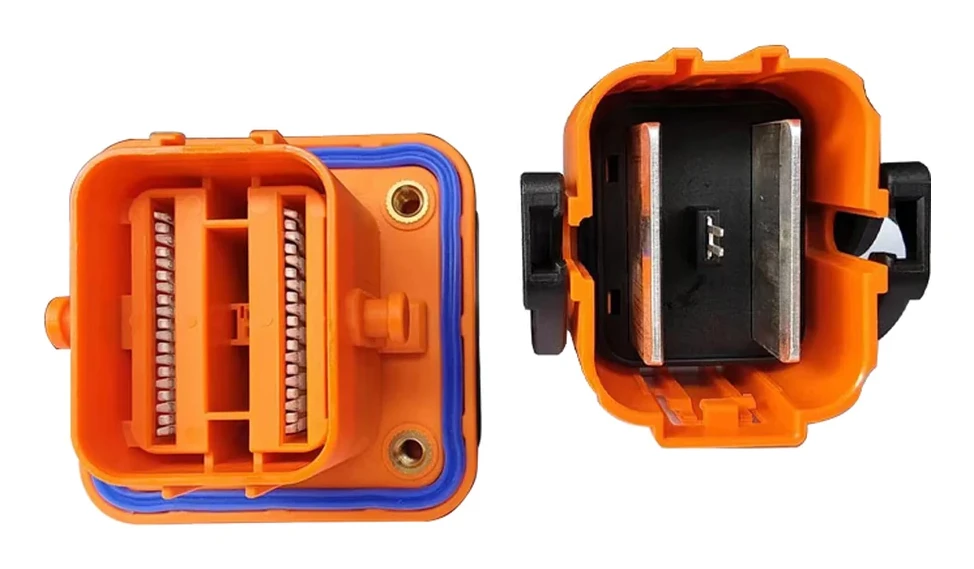
A manual service disconnect exists so a technician can break the high-voltage bus by hand before touching anything. It is operated deliberately, at zero or near-zero current, to make the pack safe. A fuse is the opposite: it operates once, under fault current, and is then scrap. Confusing the two is the most common mistake in a first battery-pack bill of materials.
What the catalog carries
Two MNS parts are published. The first is a compact fuse-less switch rated 350 A, with a two-pin plug-in body, a PA66 glass-filled insulator, IP67 sealing and a lever with a two-stage press-to-unlock interlock. The second is a housing that covers a whole pack range: eighteen versions from 80 A to 400 A, in front-mount and rear-mount variants, also IP67.
Neither listing publishes a rated voltage. That is a gap in the source data, not an omission in the catalog, and it has to be closed with the supplier before the part goes into a design.
Sizing the switch
- Match the switch to the continuous pack current, not to the fault current. The fuse or contactor upstream handles faults.
- Leave headroom for derating inside a sealed enclosure. A switch rated at the pack's continuous current has no margin once ambient rises.
- Pick front or rear mounting from the service access, not from the drawing. A rear-mount switch behind a sealed lid cannot be operated without opening the pack.
- Check the interlock. A two-stage press-to-unlock lever is what stops a live cover being lifted by accident.
Why there are two price levels
The 350 A fuse-less switch lists at ¥98, while the 80–400 A ladder starts at ¥430 per unit. That is a fourfold gap for parts that both call themselves MNS, and it reflects different construction: contact mass, housing, terminal arrangement and the number of moulded parts all differ. A buyer who assumes the cheaper part is the same switch at a smaller rating will be disappointed at incoming inspection.
Both are published because both are real, orderable parts. Which one belongs in a pack depends on the continuous current and the enclosure, not on the price.
What to ask before ordering
Ask for the rated voltage, the short-time withstand current, the terminal torque and the mating-cycle life in writing. Ask whether the switch is break-rated or isolation-only — the difference decides whether it can be operated under load. None of these are in the public listing, and a quotation is the right place to pin them down.