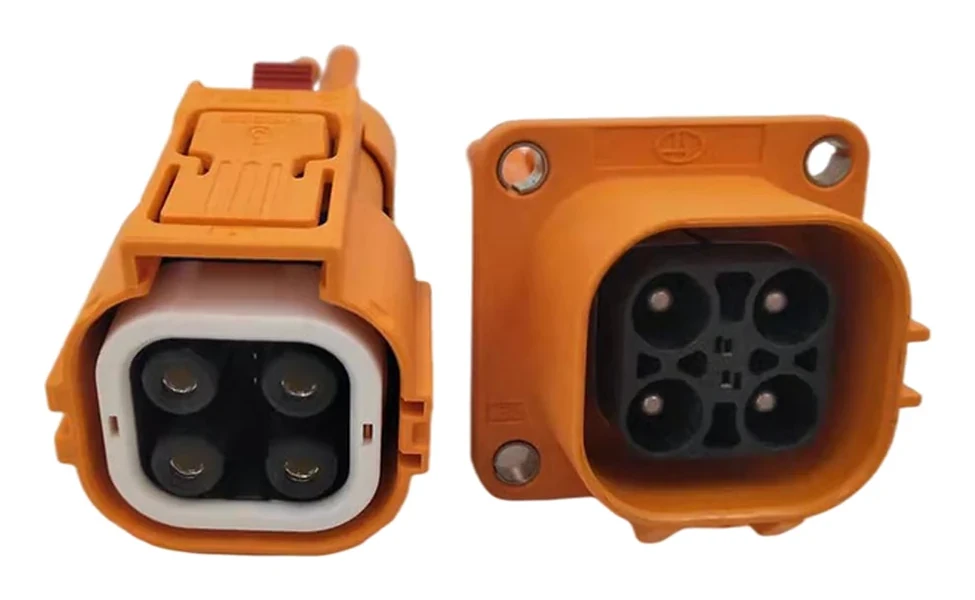
Multi-core connectors in this catalog — three, four, five and six cores — are each published in 2.5, 4.0 and 6.0 mm². On paper the three sizes are interchangeable variants of one part. In practice they behave like three separate products with three separate stock positions, and right now several of the larger sizes are sold out while 2.5 mm² keeps moving.
What the cable size actually changes
The shell, the latch, the keying and the panel cut-out are shared. What changes is the contact: a crimp barrel sized for the conductor, and a rear seal sized for the insulation diameter. Roughly, 2.5 mm² is about 13 AWG, 4.0 mm² about 11 AWG and 6.0 mm² about 9 to 10 AWG. Move a size up and the contact and the wire seal both have to change, which is why a supplier cannot simply substitute 6.0 for 2.5 on a short lead time.
Where the sold-out positions sit
- The six-core ST535000 is published in 2.5 mm² only; 4.0 and 6.0 mm² are quoted on request.
- The five-core ST533000 is the same: 2.5 mm² listed, larger sizes on request.
- The four-core part keeps 2.5 mm² in stock in both plug and socket, while 4.0 and 6.0 mm² are currently sold out at the source.
- The three-core part still carries all three sizes in both halves, which makes it the safe choice when a 6.0 mm² run is unavoidable.
Planning around a sold-out size
Two options are open to a buyer who needs 6.0 mm² and finds only 2.5 mm². The first is to change the connector family — the three-core part is published in all three sizes and can often absorb the run. The second is to order the size that exists and accept a short pigtail of smaller cable, which is only defensible when the current really is low.
What is not a good option is to assume the listing will restock inside a quotation window. A sold-out contact size on a supplier page can sit at zero for weeks, and the honest planning assumption is that it is unavailable until a date is confirmed in writing.
The current question behind the size
None of these multi-core listings publish a rated current — they describe themselves as small-current or low-current parts and leave the figure out. Cable size is not a substitute for a rating: 2.5 mm² can carry considerably more than a small-current shell's contacts, so the connector, not the wire, is normally the limiting element. A current rating has to be requested for the specific part before the design is fixed.