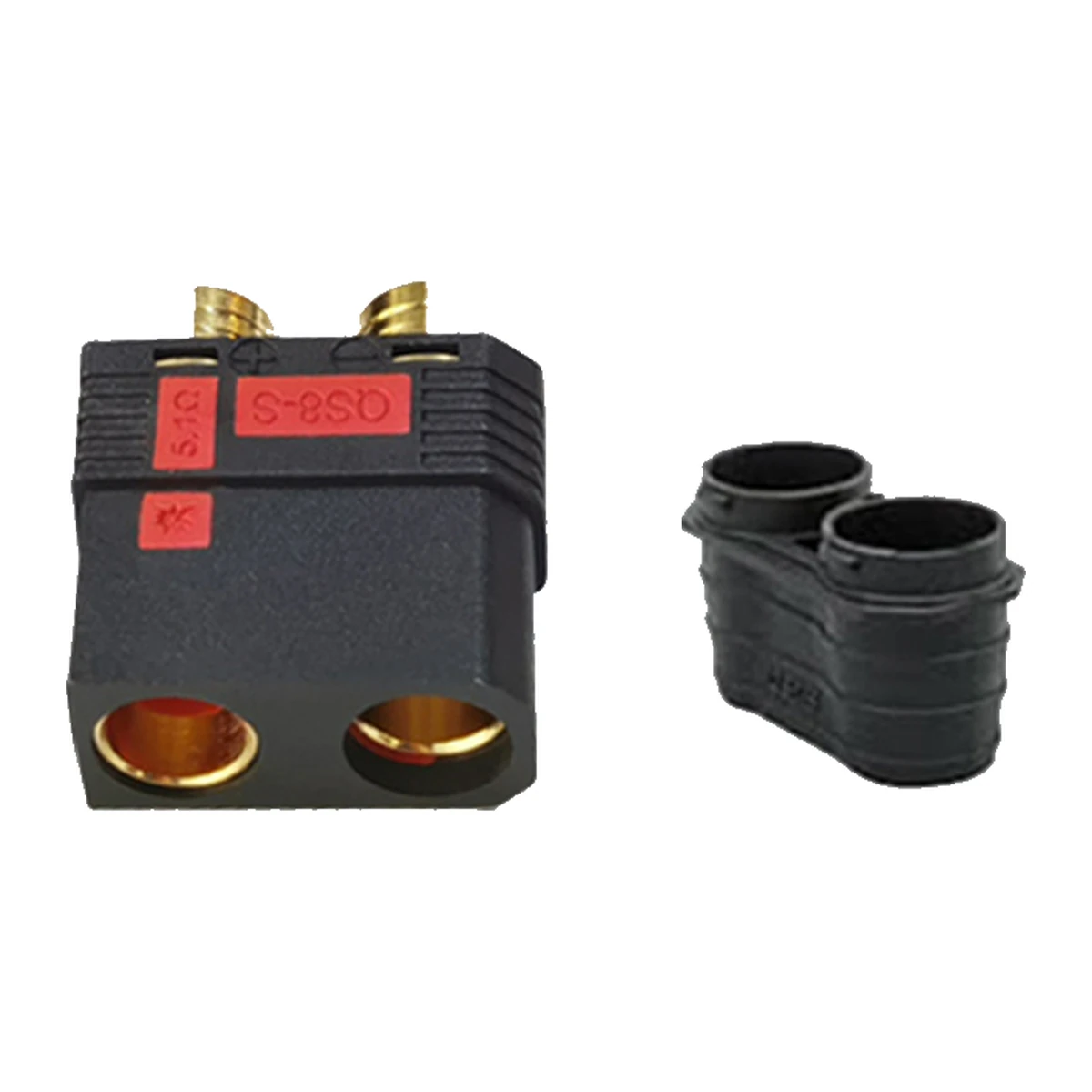
"QS8 anti-spark" is a common way to ask for a battery connector, and it treats anti-spark as if it came with the series. It does not. A QS part is a housing with a contact set; anti-spark is a separate feature that has to be stated on the listing for the specific model.
In this catalog the feature is published on three parts out of the seventy in the QS family, all of them in the QS10 shell. Every other QS page carries no anti-spark figure at all.
The three parts that publish it
These three carry a Feature row reading "high current anti-spark", and that row is the only place the property is claimed:
- QS10P-U — panel-locking high-current battery connector, 2-6 AWG, soldered.
- QS10P-S — panel-locking high-current battery connector, 6-12 AWG, soldered.
- QS10-8U — high-current battery connector, 2-6 AWG, soldered.
What the other QS parts publish instead
The remaining pages are specified by termination, wire gauge, gender and application — the fields that decide whether the connector physically works in the harness. Those are the fields to choose from:
- Termination is soldered across the family, so the joint is made at the bench, not with a crimp tool.
- Wire gauge is published per part and ranges from 2-6 AWG on the largest shells down to 8-12 AWG on the smaller ones.
- Gender is stated as male and female, which in practice means the part is the mating pair rather than half of one.
- Application fields name the usual duty: new-energy battery, drone, electric motorcycle, RC model.
If the anti-spark function is a requirement, say so in writing
A buyer replacing a connector on a pack that pre-charges through the connector should not assume the replacement does the same job because the shell matches. Ask for the feature against the exact model number and have the answer on the quotation, so the specification travels with the order instead of with the conversation.
This is the same rule the part pages follow: where the source listing does not state a figure, the cell is left blank instead of being filled with what the rest of the series usually carries.
The QS family carries the widest minimums in the catalog
The smallest minimums here are the smallest anywhere in the catalog: nine parts ship from a single piece, and eight more from two. Those are mostly adapters, where one unit is a sample rather than an order. Thirty-two parts run from three pieces.
At the other end, the two 500-piece minimums in the catalog are also in this family. The per-part figure is printed on every page, so the quantity to plan around is on the page you are reading, not in a general policy.
The price span follows the part type
Parts run from $1.14 to $67.49 per piece, EXW Yueqing. The bottom of that range is a small two-position battery connector rated AC 125 V; the top is an adapter, which is a low-volume part made to join two connector types rather than a connector in its own right.
Comparing a QS8 to a QS13 on unit price alone therefore compares a bulk connector to a conversion part. The model index lists every QS part with its price on one page when that comparison needs to be made properly.