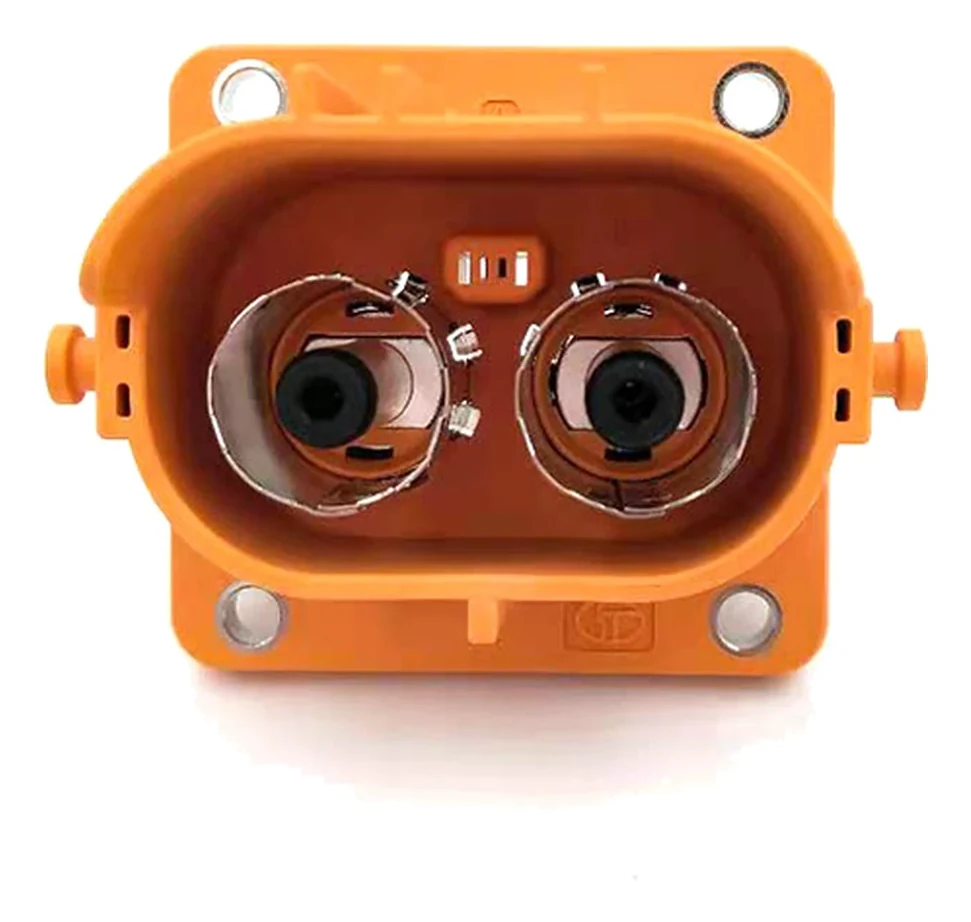
Barrel diameter is the first number an EV harness engineer looks at, and it is easy to read it as a current rating. In this catalog it is not: the 8 mm and 9 mm connectors both publish 250 A. What actually changes between them is the number of cores a single shell carries and the way the plug keys into the socket.
The 8 mm family
Three 8 mm parts are published. The single-core version is rated 2000 V at 250 A and comes as a straight plug, a 90° plug or a panel socket for 25, 35 or 50 mm² cable. The two-core version is rated 1500 V at 250 A over the same cable range. The three-core version carries the same 8 mm barrel but splits the shell into three contact chambers for three-phase charging leads and battery-to-inverter runs.
There is also an aluminium-shell single-core version, for panel sockets that have to take mechanical load and heat on the pack itself.
The 9 mm family
The 9 mm two-core part is also rated 1500 V and 250 A, with the same 25 / 35 / 50 mm² cable range. The larger barrel buys contact area and wall thickness rather than headline current: it suits a harness where the cable is at the top of the range and the plug has to survive repeated mating on a serviceable pack.
It is published as a 90° plug and a panel socket. The straight plug and the smaller 90° sizes are quoted on request rather than listed, because the supplier does not publish a firm price for them.
How to choose
- Count the cores first. One heavy lead, two leads, or three phases — that decides the family before any rating is compared.
- Check the cable range against the contact. All the 8 mm and 9 mm parts published here accept 25 to 50 mm²; a 16 mm² lead needs a smaller barrel.
- Decide whether the joint has to be serviceable. A panel socket plus a latching plug is the pattern for a pack that gets opened; a moulded harness end is not.
- Then compare price. The wider barrel and the extra hardware show up in the unit price, not in the amp figure.
What the listings do not tell you
The source listings publish voltage, current, core count and cable range, but not IP rating, temperature range or mating-cycle life for these parts. Those three are worth asking about explicitly before a design freeze, and a quote request is the place to do it — the answer has to come from the supplier's own data, not from an assumption about what an 8 mm barrel usually achieves.